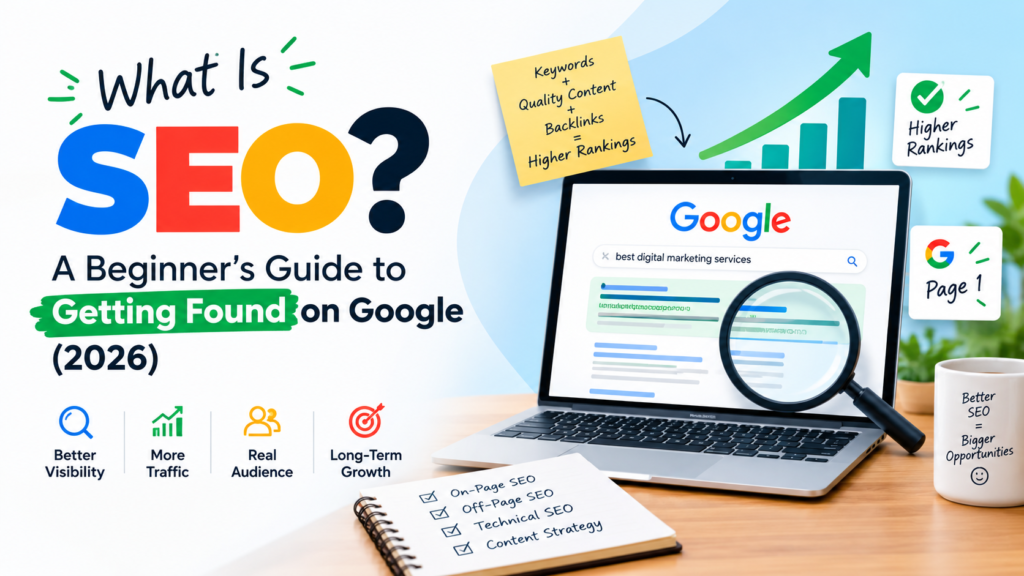
What Is SEO? A Beginner's Guide to Getting Found on Google (2026)
Introduction
Imagine opening a small shop on a street where nobody ever walks past. The products are great, the owner is friendly, but no one knows the shop exists. That is what a website without SEO feels like.
Every day, millions of people type questions into Google: how to fix a leaking tap, which laptop to buy, how to learn digital marketing. The websites that show up first get the visitors. The rest stay invisible. SEO is the skill of making sure you are one of the websites that show up.
What Is SEO in Simple Words?
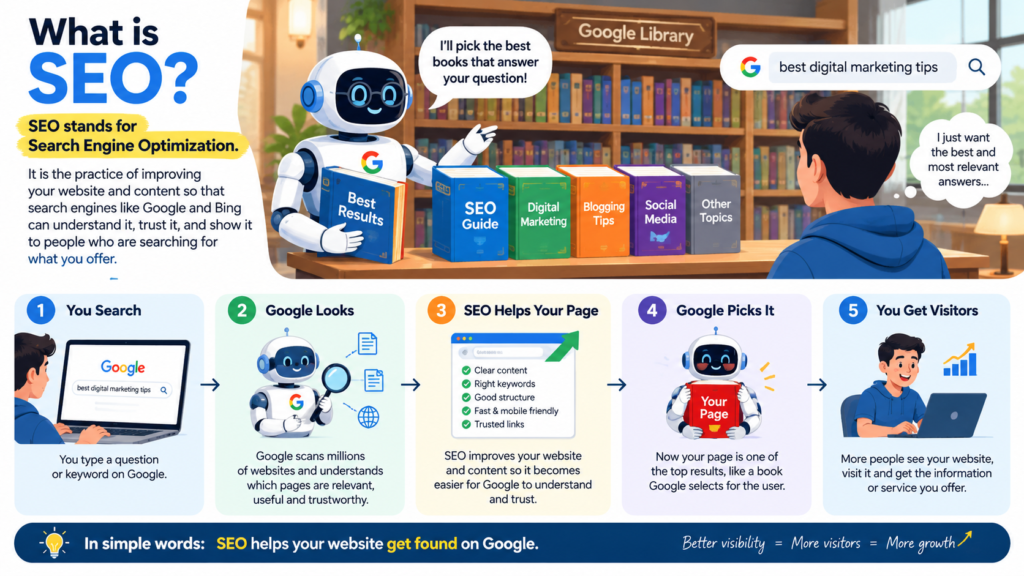
SEO stands for Search Engine Optimization. It is the practice of improving your website and content so that search engines like Google and Bing can understand it, trust it, and show it to people who are searching for what you offer.
Think of Google as a very smart librarian. When someone asks a question, the librarian does not hand over every book in the building. They pick the few that best answer the question. SEO is how you help your page become one of the books the librarian picks.
How Do Search Engines Work?
Search engines do three things. They crawl, which means bots follow links to discover pages. They index, which means they read each page and save it in a huge database. Then they rank, sorting indexed pages by how well they answer a search.
Search engines crawl, index, then rank, and SEO works on the ranking
1. Crawl
Bots follow links todiscover your pageNeeds links pointing to it
2. Index
The page is read andsaved in a huge database Only indexed pages show up
3. Rank
Pages are sorted by howwell they match the searchThe step SEO influences
A page must be found and stored before it can appear, and ranking is the step SEO tries to influence.
Why Does SEO Matter?
• It brings in people who are already interested. Someone searching “best running shoes for flat feet” is actively looking to buy. You are not interrupting them, you are answering Why Does SEO Matter?
• them.
• It builds trust. People tend to trust pages that appear naturally at the top of results more than ads.
• It keeps working. A good article can bring visitors for years without you paying for every click.
• It is affordable. You can start with free tools and your own time.
• It levels the field. A small business with great content can compete with a big brand for specific searches.
The Three Pillars of SEO
Most of SEO fits into three areas. Think of them as the three legs of a stool: if one is weak, the whole thing wobbles.
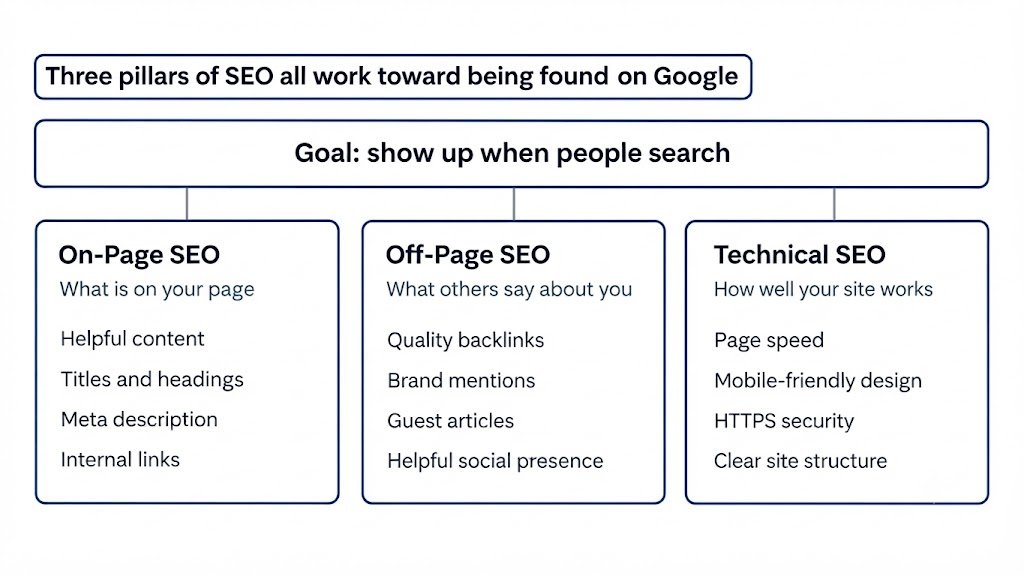
Content, reputation and site health each carry part of the weight, and a weak one makes the other two wobble.
- On-page SEO is everything you control on a page: helpful content, clear titles and headings, a good meta description, image alt text and internal links.
- Off-page SEO is your reputation across the web, mainly backlinks: links from trusted sites act like votes of confidence.
- Technical SEO is how well your site works: fast pages, mobile-friendly design, HTTPS security and a clear structure.
Keywords and Search Intent
A keyword is the word or phrase someone types into a search engine, and search intent is the reason behind that search. Someone searching “what is SEO” wants to learn, so a sales pitch will make them leave, while someone searching “best SEO tools” is comparing options before buying. Match your page to the intent behind the keyword, and both visitors and search engines will reward you.
How Long Does SEO Take?
There is no fixed answer, but for a new website it is common to wait three to six months or more before seeing steady results. It depends on how competitive your topic is, how good your content is, and how consistently you publish. Treat SEO like planting a tree: slow at the start, powerful later.
A Simple 7-Step SEO Plan for Beginners
- Pick a topic and audience. Decide who you are helping and with what.
- Do keyword research. Find phrases your audience searches, starting with less competitive, specific ones.
- Check search intent. Look at what already ranks and what kind of page it is.
- Write a genuinely helpful page. Answer the question clearly, with examples and your own experience.
- Optimise the basics. Use a clear title, headings, meta description, image alt text and internal links.
- Fix the technical basics. Make sure the site is fast, mobile-friendly and secure.
- Track and improve. Use Google Search Console to see what is working, then update and repeat.
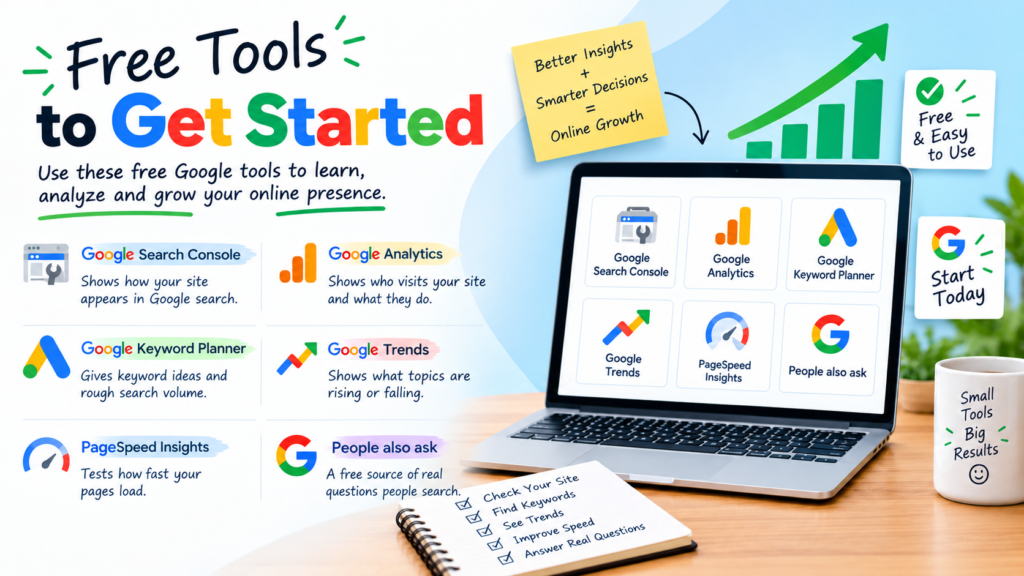
Free Tools to Get Started
- Google Search Console: shows how your site appears in Google search
- Google Analytics: shows who visits your site and what they do
- Google Keyword Planner: gives keyword ideas and rough search volume
- Google Trends: shows what topics are rising or falling
- PageSpeed Insights: tests how fast your pages load
- Google’s “People also ask” box: a free source of real questions people search
Common SEO Mistakes Beginners Make
- Stuffing keywords until the writing sounds robotic
- Copying content from other websites
- Ignoring mobile users
- Skipping the meta title and description
- Expecting results in one week and giving up too soon
- Publishing once and never updating
- Chasing cheap backlinks instead of earning good ones
Frequently Asked Questions
Is SEO free? The clicks are free, but SEO costs time and effort, and sometimes tools or help from professionals.
Is SEO still worth it with AI answers in search? Yes. Search engines still need trustworthy, useful, original sources to learn from and link to, and people still click through for depth, tools and real experience.
Conclusion
SEO is not a trick or a secret. It is the habit of understanding what people are searching for and building the most helpful, trustworthy answer on the internet for them. Start small: pick one topic, research it properly, write something genuinely useful, and keep improving it.
If this guide helped you, share it with a friend who is just getting started, and tell us in the comments which part of SEO you want to learn next.