
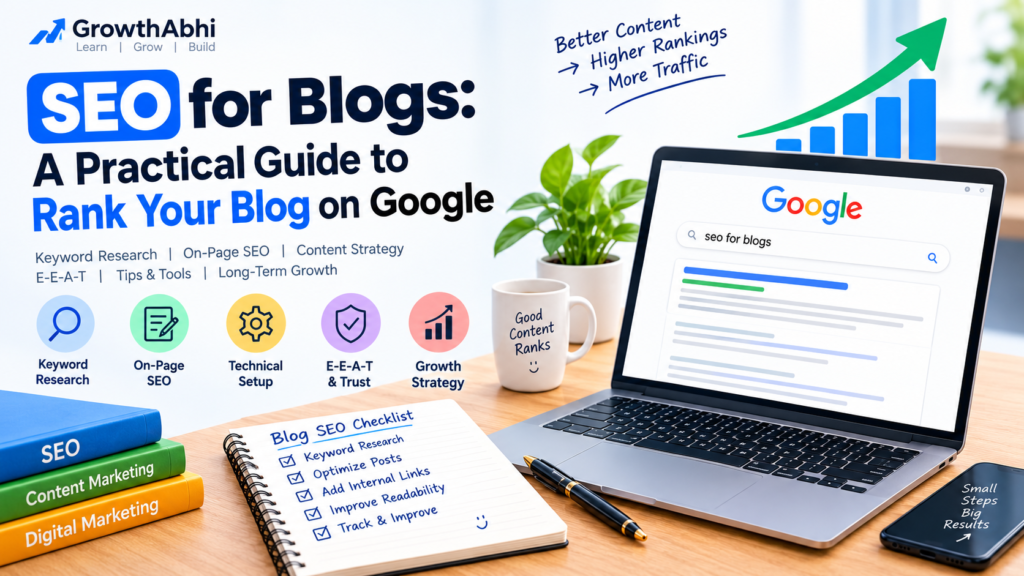
SEO for Blogs: A Practical Guide to Rank Your Blog on Google
By Abhay Pandey (Digital Marketing Excutive), Digital Marketer at GrowthAbhi | Last updated: October 2026
You wrote a good post, hit publish, and then… nothing. No visitors, no ranking. If this sounds familiar, the problem is usually not your writing. It is that Google never understood who the post is for and why it deserves to rank.
This is where SEO for blogs comes in. In this guide I will share the exact process I follow while working on blogs as a digital marketer: how to research topics, how to optimize each post, and how to build a long-term plan that Google trusts.
Quick answer: SEO for blogs means creating helpful content around what people actually search for, structuring it so search engines can understand it, and showing real experience and trust so Google wants to rank it.
What Is SEO for Blogs?
SEO (Search Engine Optimization) is the practice of making your content easy to find on Google. For a blog, it covers three things:
- Content: Answering the exact question a reader types into Google.
- Technical setup: Fast loading pages, mobile-friendly design, clean URLs.
- Trust: Proof that a real, knowledgeable person wrote the article.
Google’s own guidance says to create helpful, reliable, people-first content. It does not reward tricks. It rewards pages that solve the reader’s problem better than others do.
Why E-E-A-T Matters for Your Blog
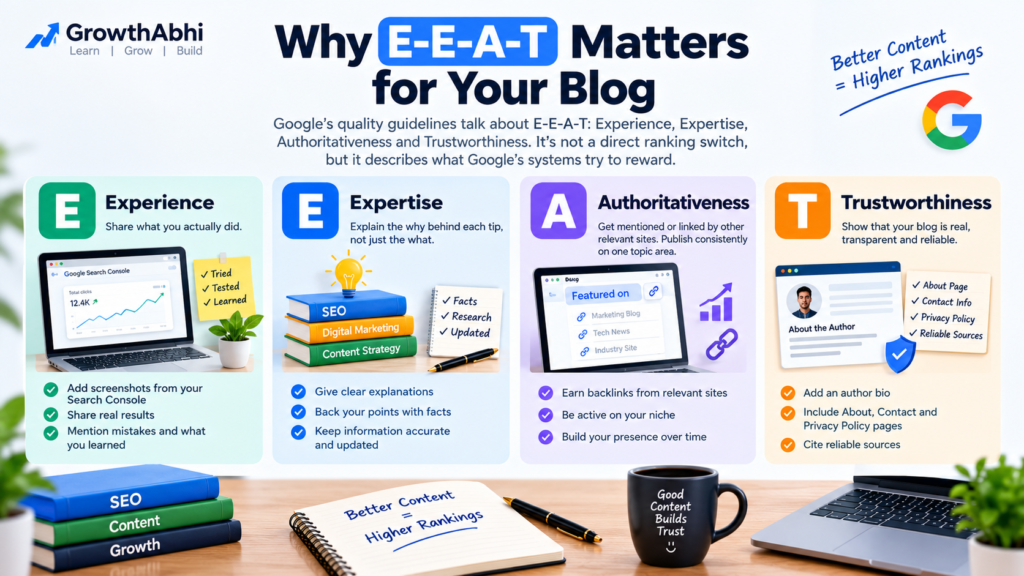
Google’s quality guidelines talk about E-E-A-T: Experience, Expertise, Authoritativeness and Trustworthiness. It is not a direct ranking switch, but it describes what Google’s systems try to reward. Here is how a blogger can show each one:
- Experience: Share what you actually did. Add screenshots from your own Search Console, real results, and mistakes you made.
- Expertise: Explain the why behind each tip, not just the what. Keep facts accurate and updated.
- Authoritativeness: Get mentioned or linked by other relevant sites. Publish consistently on one topic area.
- Trustworthiness: Add a clear author bio, an About page, contact details, a privacy policy, and cite reliable sources.
If your blog has no author name and no proof of experience, Google (and readers) have little reason to trust it.
Step 1: Blog Keyword Research
Every good post starts with blog keyword research. A keyword is simply the phrase a person types into Google.
- List topics from your niche and from questions your audience asks.
- Check search intent. Search the keyword yourself. Do the top results show guides, lists, or product pages? Match that format.
- Use free tools. Google Search Console, Google Keyword Planner, Google Trends, and the “People also ask” box all give useful ideas.
- Pick realistic targets. A new blog should start with long-tail keywords (4+ words, lower competition) before going after big terms.
- One main keyword per post, plus a few related phrases that appear naturally.
Tip: Do not chase volume alone. A keyword with 100 monthly searches and clear intent often brings better readers than one with 10,000 vague searches.
Step 2: How to Optimize Blog Posts
Here is a simple checklist for how to optimize blog posts before you publish:
- Title tag: Include the main keyword near the start, keep it under about 60 characters, and make it click-worthy.
- Meta description: Around 150 to 160 characters. It does not directly affect ranking, but a good one improves clicks.
- URL slug: Short and readable, like
/seo-for-blogs. - Headings: One H1, then logical H2 and H3 headings. Use them to organize ideas, not to stuff keywords.
- Introduction: Answer the main question in the first few lines.
- Images: Compress them, add descriptive file names and alt text that actually describes the image.
- Internal links: Link to your related posts using natural anchor text.
- External links: Link to trustworthy sources when they genuinely help the reader.
- Readability: Short paragraphs, simple words, bullet points where useful.
- Mobile and speed: Most readers visit from phones. Test with PageSpeed Insights.
About keyword density
Google has never given a fixed keyword percentage. Its spam policies warn against keyword stuffing, meaning repeating phrases unnaturally. So use your main keyword in the title, the introduction, one or two headings, and a few natural places in the body. Write for the reader first, and use synonyms and related phrases.
Step 3: SEO Tips for Bloggers That Actually Work
These SEO tips for bloggers come from what tends to work in real projects:
- Update old posts. Refresh data, fix broken links, and add new sections. Fresh and accurate content earns trust.
- Add original value. Include your own examples, simple tables, or case notes. Do not just rewrite what is already on page one.
- Improve click-through rate. Look at Search Console for posts with many impressions but few clicks, then rewrite their titles.
- Build topic clusters. Write one main guide and several smaller posts around it, all linked together.
- Earn links the right way. Share useful resources, write guest posts on relevant sites, and avoid buying links.
- Be consistent. A steady schedule beats random bursts.
- Avoid AI-only or copied content. Use AI as a helper if you like, but add your own experience, check the facts, and edit properly.
Step 4: Build a Blog SEO Strategy
A blog SEO strategy connects all the steps above into one repeatable plan:
- Define your audience. Who reads your blog and what problem do they have?
- Choose 3 to 5 core topics you can write about with real knowledge.
- Make a content calendar based on keyword research.
- Publish and optimize each post using the checklist above.
- Track results in Google Search Console and Google Analytics: impressions, clicks, average position, and engagement.
- Review every 3 months. Update what is slipping and double down on what works.
SEO is a long game. Most new blogs need a few months before they see steady traffic, so patience and consistency matter.
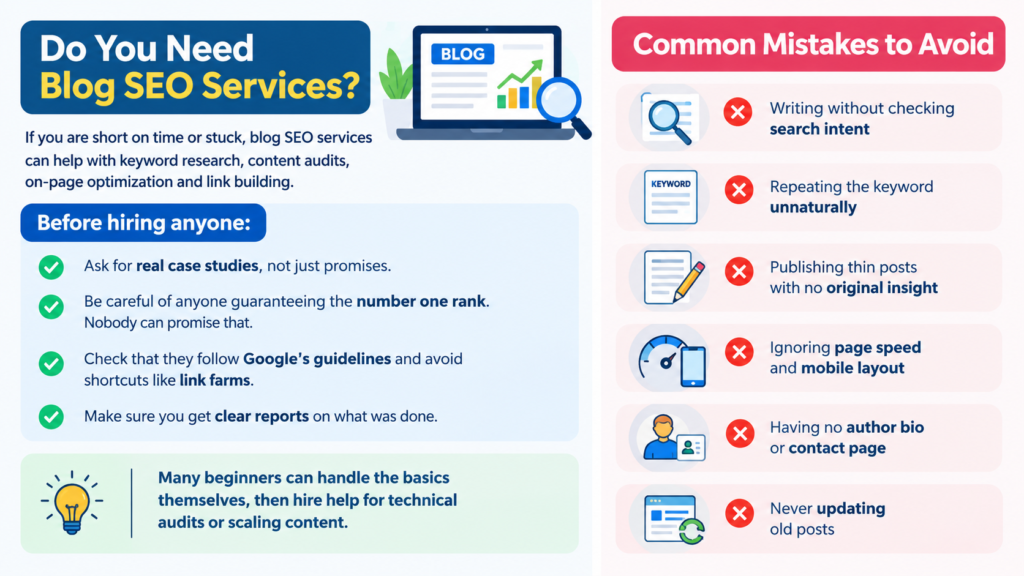
Do You Need Blog SEO Services?
If you are short on time or stuck, blog SEO services can help with keyword research, content audits, on-page optimization and link building. Before hiring anyone:
- Ask for real case studies, not just promises.
- Be careful of anyone guaranteeing the number one rank. Nobody can promise that.
- Check that they follow Google’s guidelines and avoid shortcuts like link farms.
- Make sure you get clear reports on what was done.
Many beginners can handle the basics themselves, then hire help for technical audits or scaling content.
Common Mistakes to Avoid
- Writing without checking search intent
- Repeating the keyword unnaturally
- Publishing thin posts with no original insight
- Ignoring page speed and mobile layout
- Having no author bio or contact page
- Never updating old posts
FAQs
What is SEO for blogs? It is the process of optimizing your blog content and site so it can rank on Google for the topics your readers search for.
How long does blog SEO take to work? Usually 3 to 6 months for a new blog, depending on competition and content quality.
How many times should I use a keyword? There is no fixed number. Use it naturally where it fits, and focus on being helpful.
Is E-E-A-T a ranking factor? Not directly. It is a framework Google’s quality raters use, and it reflects what Google’s systems aim to reward.
Conclusion
Good SEO for blogs is not about tricks. It is about understanding your reader, researching the right keywords, optimizing each post carefully, and showing real experience over time. Start with one post, follow the checklist, track the results, and improve step by step.
About the author: Abhay Pandey (Digital Marketing Executive) works in digital marketing and writes at GrowthAbhi about practical SEO and blogging. Add your real experience, years in the field, and a photo here.
Sources to cite: Google Search Central (SEO Starter Guide), Google’s guidance on creating helpful, people-first content, Google’s spam policies.